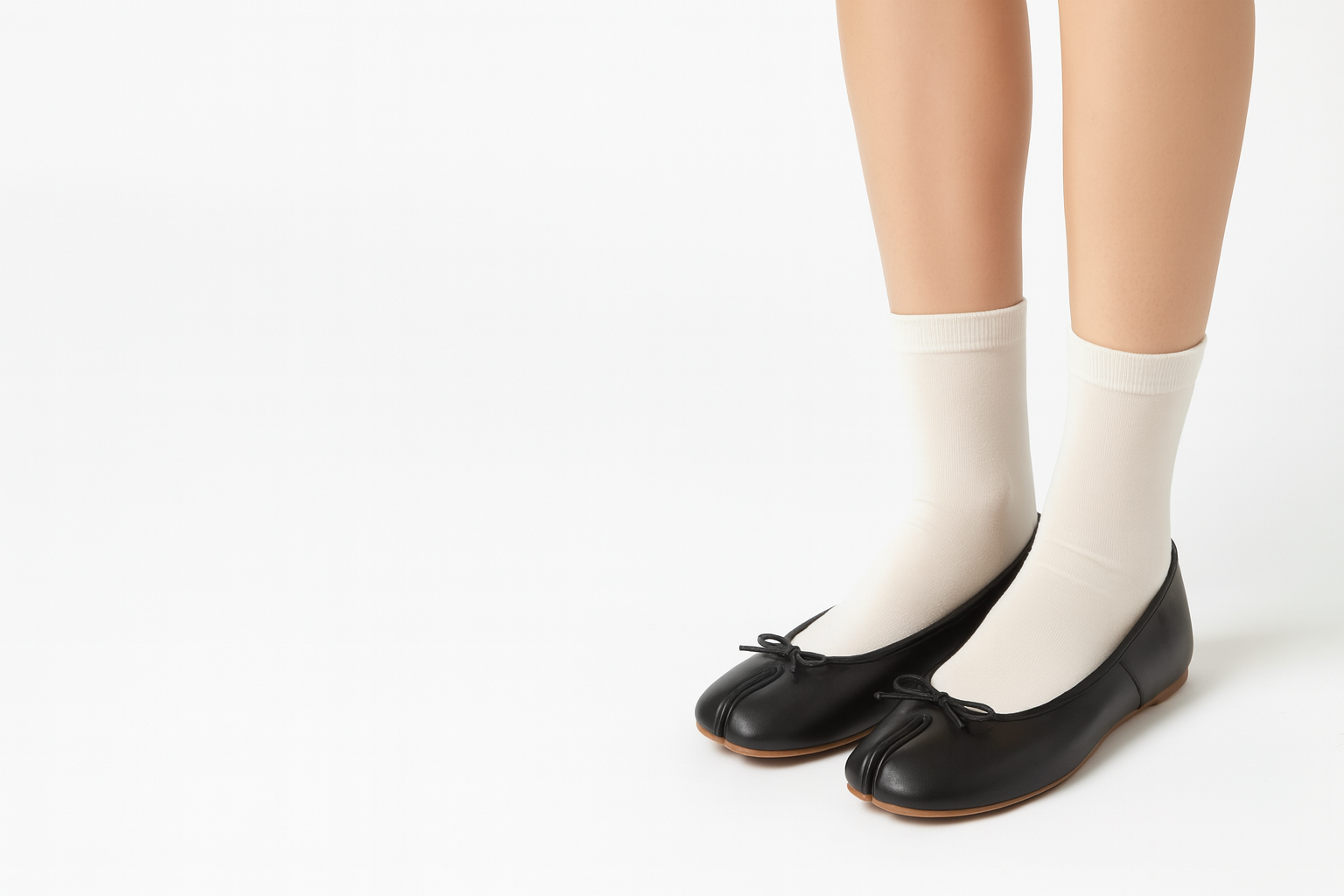
Are tabi socks good for your feet?
Are you wondering whether Japanese tabi socks, which separate the big toe, can truly improve your comfort and foot health? Let’s take a closer look at their real benefits, their limitations, and the situations in which they can be useful.
What are tabi socks?
Tabi socks are traditional Japanese socks that separate the big toe from the other four toes. This unique design dates back to the Heian period and was created to meet a specific practical need.
Unlike regular socks, traditional tabi rise to mid-calf and fasten at the back with small metal hooks called kohaze. They are typically made from cotton and feature a thicker sole than standard socks.
The separation of the big toe is intentional. It allows you to wear traditional Japanese footwear such as geta or zōri, which fit between the big toe and the others. Without this design, wearing them comfortably would be impossible.
Today, more modern elastic versions are available, making them easier to put on. There are also jika-tabi, reinforced with a rubber sole and used directly as work footwear.
To wear tabi socks, you’ll need suitable shoes: Japanese sandals, flip-flops, or footwear specifically designed for this type of sock.
The benefits of tabi socks for foot health
Tabi socks offer several concrete advantages for your feet. By isolating the big toe, they allow for better weight distribution, which naturally improves posture and balance. This design can also promote better blood circulation.
Improved posture and balance
Separating the big toe changes the way you stand. By returning to its natural position, your big toe becomes a true pillar of stability, creating a fifth point of support that improves your grounding.
This redistribution of weight across the entire foot affects your whole body. Your spine aligns more naturally, reducing tension in the back, hips, and knees. Some studies even suggest up to a 20% reduction in knee pressure while walking.
Tabi socks also enhance proprioception—the ability to sense your body’s position in space. Each toe can move independently, improving your awareness of ground contact. The result: smoother, more controlled movements.
That’s why many martial artists, yogis, and runners adopt them. They recreate a barefoot-like sensation while still providing protection.
Prevention of blisters and irritation
Tabi socks almost eliminate blisters between the toes. By separating each toe, they prevent direct friction, which is the main cause of irritation.
This becomes especially useful during sports or long walks. Toes no longer rub against each other, even when your feet sweat or swell slightly.
Separating the toes also improves airflow. Moisture escapes more easily, reducing the development of bacteria responsible for skin irritation. Absorbent materials like cotton or lyocell enhance this effect.
For people prone to corns or bunions, this separation significantly reduces localized pressure. The big toe regains its natural space instead of pressing against the others.
The result: less inflammation, fewer sensitive areas, and greater comfort even after a long day. This is why many runners and hikers adopt them permanently.
Using tabi socks for specific needs
Tabi socks are particularly well suited to situations where your feet have specific needs.
For foot conditions
If you suffer from hallux valgus (bunions), compression models can help reposition the big toe and relieve tension. Some podiatrists even recommend them to slow the progression of this condition. For flat feet, separating the big toe improves stability and naturally strengthens foot muscles.
For sports and martial arts
Athletes appreciate their ability to improve balance and proprioception—especially in martial arts, where contact with the ground is crucial. Non-slip sole models provide additional grip during movement.
Runners often use them to reduce friction between toes and prevent blisters over long distances. They also mimic the sensation of barefoot running, appealing to fans of natural running.
In most cases, they can be worn with everyday shoes without major constraints.
Limitations and drawbacks of tabi socks
Despite their advantages, tabi socks are not suitable for everyone or every situation.
The main challenge is adapting to the separation of the big toe. Some people experience initial discomfort, similar to wearing flip-flops for the first time. This sensation may last a few days before fading.
In practical terms, they also have limitations outdoors. Without a protective sole, they are not suitable for long walks on rough terrain. Their use is therefore mainly indoors or with closed shoes.
Maintenance can require extra care as well. Depending on the material, they may need gentle washing to preserve their shape and durability.
Finally, their unique design limits the range of compatible footwear. Some tight or narrow shoes do not accommodate toe separation well.
These drawbacks are minor for most users, but they are worth considering before purchasing.